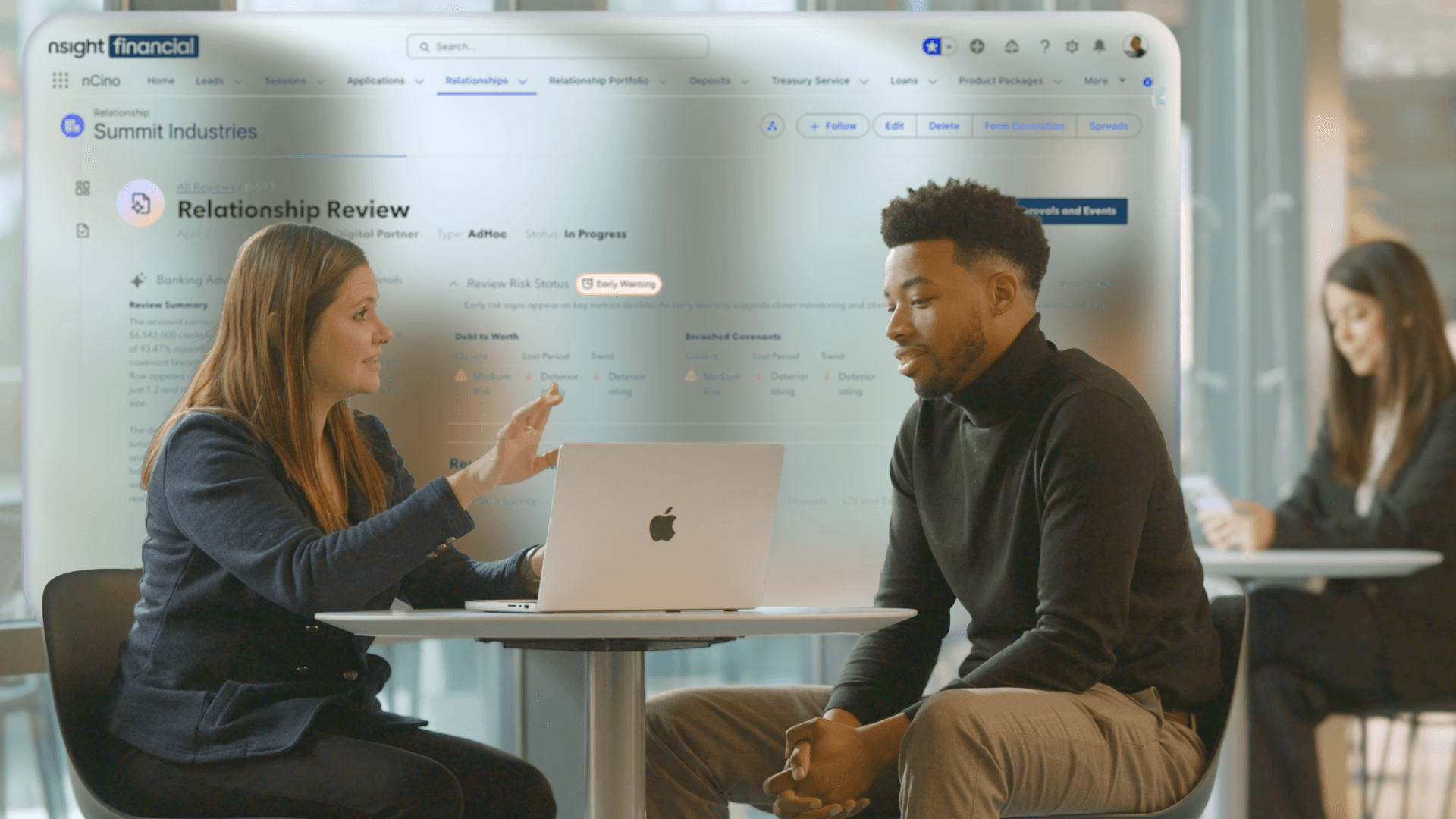
Buy and Build: Buy the Banking Foundation, Build on Top

The build versus buy debate has a new answer in the AI era: buy a proven banking intelligence foundation, then build your differentiation freely on top.
AI has given the old build-versus-buy question a sharper answer: buy a proven intelligence foundation, then spend your own build energy on what sets you apart. Building in-house has been the default for many institutions, for reasons ranging from control to fit with existing core systems. AI raised the stakes of that choice because building banking-grade intelligence in-house is a far bigger undertaking than the workflow systems that defined the old debate.
Buying Puts AI Capabilities in Place From Day One
Buying an intelligence-ready platform puts working AI in place from day one. That's a real head start, because building the same capability in-house is a serious commitment. It calls for a unified data foundation across commercial, consumer and mortgage operations, domain-specific models, continuous learning, explainability frameworks for regulators and auditors, and ongoing governance.
Altogether, that's a costly, multi-year programme and most companies are waiting on the payoff: Boston Consulting Group found that (opens in a new tab) 74% of companies have yet to show tangible value from AI, with only 26% moving beyond proofs of concept.
The Data Advantage That Compounds With Every Deal
Any institution can buy the same AI models, but nCino's 14+ years of deal structures, covenant data and workflow patterns drawn from real banking operations is a real differentiator. That context is what tells an AI model what matters in a loan, a covenant or a risk decision. It's built over years, not months, and it's the reason a bought foundation can be a better choice than an in-house build starting from a blank data set.
Buying Frees Scarce AI Talent for the Work That Sets You Apart
Cost is the other half of the decision, and most of it is people. Fifth Third Bank's CIO estimated that building the same capability in-house would have cost twice as much as buying it.
However, the steepest line item is talent. Harvard Business Review notes (opens in a new tab) that building software in-house means competing for highly paid engineers, with search firms alone adding 15% to 30% of first-year salary, and the premium for AI and data science specialists runs higher still. BCG finds that (opens in a new tab) roughly 70% of the challenges in AI initiatives trace back to people and process rather than the technology.
Institutions on the nCino Platform get our Digital Partners and Operations Analytics without standing up the data science function underneath, freeing that scarce talent for the products and decisions that set them apart.
The Strongest Move Buys the Foundation and Builds the Differentiation
The institutions that handle this best describe a deliberate strategy: buy the foundation, then direct their own development toward genuine differentiation. Banque Raiffeisen Luxembourg (opens in a new tab) chose to follow standard processes for credit granting instead of rebuilding the customisation layered onto its old core, freeing its team to build where it creates real advantage. Bendigo Bank (opens in a new tab) consolidated more than 30 forms and systems onto the nCino Platform and reached 87% out-of-the-box, with leadership keen to standardise even further.
A proven foundation carries the AI, the compliance context and the banking workflows. Your build effort goes to the products and experiences that make your institution distinct.
Get the Full Guide
Buy and Build: A Strategic Guide for Financial Institutions lays out the complete decision framework: the three factors that should drive the choice, the questions to ask before you commit, and the three-stage journey from proven foundation to AI-native banking.